

How Do I Stop Important Tasks Falling Through the Cracks in My Business?
You can feel it before you can name it. A client mentions something you'd promised three weeks ago and you can't remember whether it was done. A supplier asks why nobody replied to their quote. A team member assumed you were chasing the contract; you assumed they were. None of these are catastrophes on their own. Stacked together, they're the signature of a business where important work is no longer being held by a system. It's being held by hope.
This article is for the MDs, founders, and senior leaders who recognise that pattern and want to fix it properly, not paper over it. At Elite Project Consulting, we're called in most often when this exact problem has tipped past the point of informal coordination. What follows is how we think about it, diagnose it, and resolve it.
Understanding Why Important Tasks Fall Through the Cracks in Your Business
What are the root causes of task oversight in business operations?
Tasks don't fall through the cracks because people are careless. They fall through because the structure underneath them was never designed to hold the volume of work the business is now carrying. Five root causes show up repeatedly in the businesses we work with.
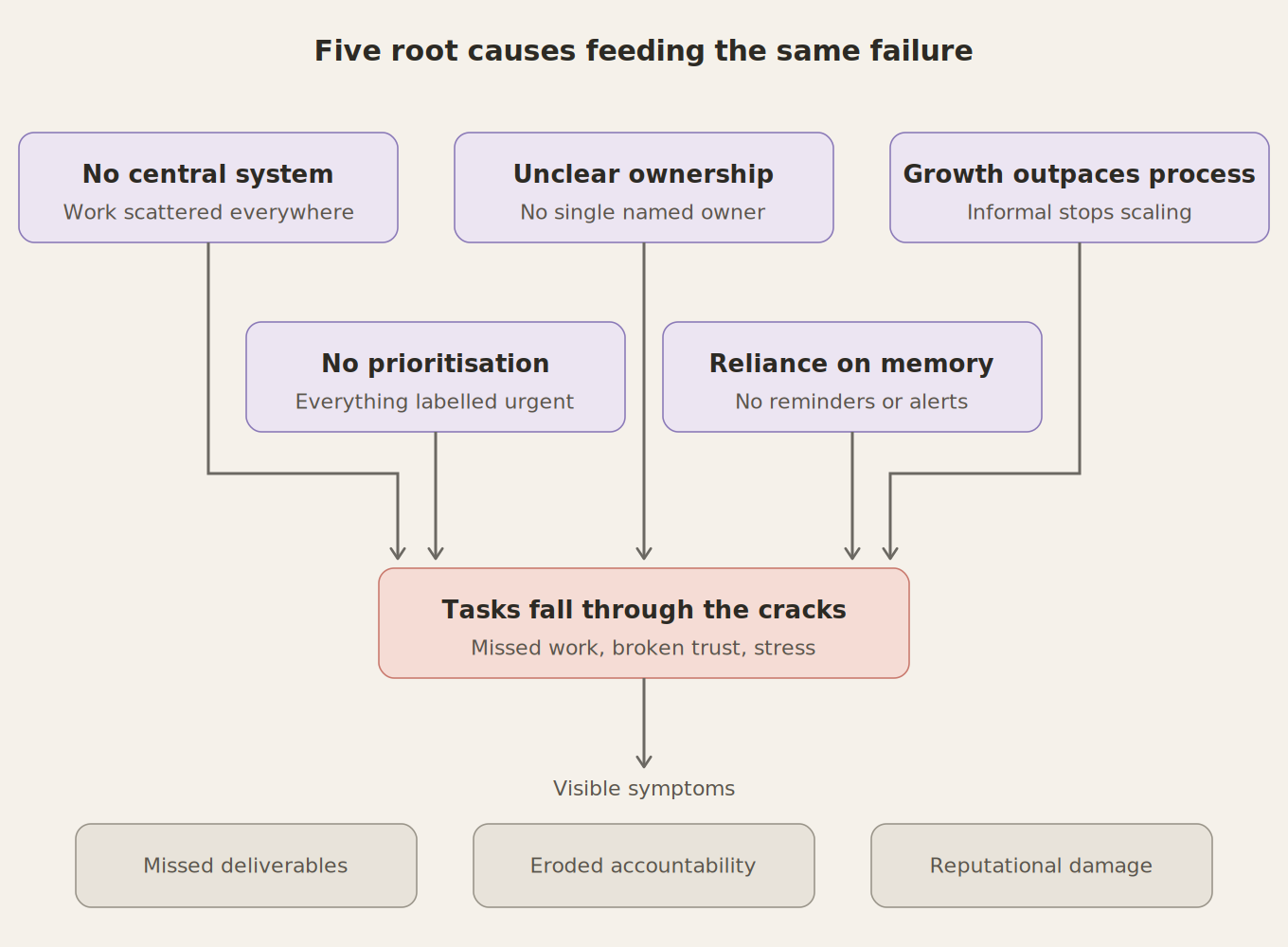
The first is the absence of a structured task management system. When commitments live in inboxes, WhatsApp threads, mental notes, and the occasional spreadsheet, there is no single surface on which to see everything that has been promised. Anything not actively in someone's line of sight effectively ceases to exist.
The second is unclear ownership. When a task is "with the team" rather than with a named person, every individual quietly assumes someone else has it. The phrase I thought you were doing that is the operational symptom of an ownership gap.
The third is growth outpacing process. The informal coordination that worked at five people breaks at fifteen. Nobody announces the threshold has been crossed. You simply notice that the same loose approach now produces chaos rather than agility.
The fourth is the absence of a prioritisation framework. When everything is described as important, nothing actually is. Tasks that genuinely matter get displaced by tasks that are merely loud.
The fifth is reliance on memory. Memory is a remarkable tool for many things; it is a catastrophic system for tracking commitments. Without external reminders and alerts, deadlines slip not because anyone forgot they cared, but because they forgot full stop.
What is the real cost of tasks falling through the cracks?
The visible cost is the missed deliverable. The actual cost is everything that flows from it.
Operationally, dropped tasks produce missed client commitments, broken internal handoffs, duplicated effort, and a steady drift away from the standard the business publicly claims to hold itself to. Each individual instance feels recoverable. The cumulative pattern is corrosive.
Culturally, repeated oversight erodes accountability. When team members watch important things drop without consequence, the implicit signal is that deadlines are aspirational rather than binding. Trust within the team softens; trust from clients softens faster.
Personally, the toll on the business owner is significant. The stress of carrying a mental list of half-tracked obligations, the anxiety of suspecting something has been missed without knowing what, and the gradual loss of confidence that the business is genuinely under control. These are the conditions we hear described most often on first calls.
There is also a measurable productivity cost. Time spent reconstructing dropped work, apologising to clients, and firefighting the consequences of poor visibility is time not spent on growth. By the time the cost shows up in client churn, reputational damage, or commercial penalties, it has already been compounding for months.
How do cognitive overload and poor planning amplify the problem?
A business owner running delivery while also running the business is making hundreds of small decisions a day. Decision fatigue is well documented in organisational psychology, and its effect on task oversight is direct. As cognitive capacity depletes through the day, the ability to maintain visibility across all active obligations degrades sharply. Tasks that would have been caught at 9am are missed at 4pm.
Without structured planning sessions, meaning a deliberate, recurring moment to review everything in flight, important work gets buried under urgent but less consequential demands. The urgent always wins in the moment. The important loses by default.
Informal to-do lists make this worse, not better. A list without deadlines, owners, and status updates gives the appearance of organisation while delivering none of its function. Items linger for weeks. New items get added. The list grows; the execution doesn't.
When delegation is unclear, a single gap in oversight becomes systemic. One person's missed handover means three downstream tasks now have no real owner. The crack widens quietly until something visible breaks.
How do I identify the specific gaps in my current business systems?
Before fixing anything, audit honestly. Three exercises are worth running.
Map every workflow that touches a client, a deadline, or a regulatory obligation. For each one, identify the points where work is handed from one person, system, or stage to another. Handoffs are where things drop. If you cannot describe the handoff precisely, the gap is already there.
Map responsibilities across the team. For each significant area of work, ask who specifically owns it end to end. If the answer is a team name rather than a person, that is the gap. If two people both believe they own it, that is also the gap.
Assess your current tools and rituals against a simple test: would a new team member, given access to your systems alone, be able to see exactly what is in flight, who owns it, and when it is due? If the answer requires a conversation, you don't have a system. You have a habit.
We call this combined exercise a task gap analysis: the distance between what the business has committed to and what is actually being tracked, executed, and verified. It is almost always larger than expected, and it is the necessary starting point for everything that follows.
How to Stop Important Tasks Falling Through the Cracks in Your Business
How do I build a reliable task management system as my foundation?
A reliable task management system is the non-negotiable foundation of work execution assurance. Without it, every other intervention is decoration.
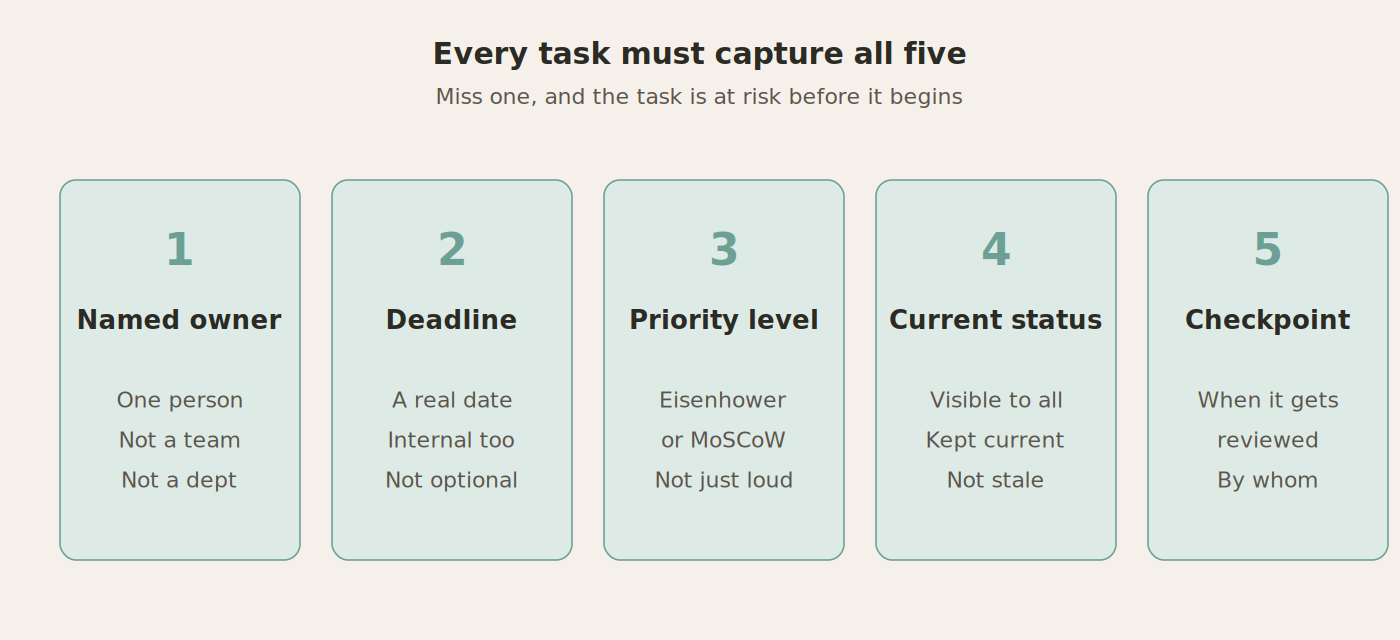
At a minimum, the system must capture five things for every piece of work: a named owner, a deadline, a priority level, a current status, and a defined accountability checkpoint at which progress is reviewed. If any one of these is missing, the task is at risk before it has begun.
Tooling matters less than discipline, but it does matter. A small business with simple workflows may be well served by a focused task manager like Todoist or Microsoft To Do. A growing business with multiple concurrent initiatives needs something more substantial, such as Asana or Smartsheet. At Elite Project Consulting we use Asana or Smartsheet extensively for clients who need PPM-grade visibility across a portfolio of work, because it scales without forcing teams into rigid methodologies they won't sustain.
The single most important design principle is centralisation. Every commitment, whether internal, external, strategic, or operational, should live in one place. The moment tasks fragment across email, chat, spreadsheets, and verbal agreements, the system has already failed.
Adoption is where most implementations collapse. A tool that the leadership team uses and the rest of the business ignores is worse than no tool at all, because it produces a misleading sense of coverage. Consistent use across every team member, with leadership modelling the behaviour, is the only configuration that holds.
How do I implement checklists and standardised processes to eliminate oversight?
Checklists are one of the most evidence-backed interventions in operational practice. Aviation and surgical medicine adopted them because the consequences of forgetting a critical step were catastrophic, and the data on their effect, particularly the WHO Surgical Safety Checklist work, is striking. Businesses can borrow the principle without the stakes.
Build role-specific checklists for recurring responsibilities. A client onboarding checklist. A new-hire setup checklist. A project closeout checklist. A monthly compliance checklist. Each one captures the steps a competent person would always intend to take, and removes the requirement to remember them under pressure.
Standardised processes convert one-off task management into repeatable workflow. When the steps for "delivering a new client engagement" are documented and embedded into the task management system as a reusable template, every new engagement starts with the full task set already populated: owners, deadlines, dependencies, all of it. Nothing relies on the person who set up the last one remembering how they did it.
Embed checklists directly into the project management tool rather than keeping them in a separate document nobody opens. The checklist should appear in the natural flow of work, not require a detour to reach.
How do I establish clear accountability and ownership for every task?
The rule is non-negotiable: every task has one named owner. Not a team. Not a department. One person.
A team can be involved. A team can support. But accountability cannot be shared without being diluted. The owner is the person whose name appears next to the task, who is asked about it in reviews, and who is responsible for raising the flag if it is at risk.
Action items must not leave a meeting unassigned. The discipline of closing every conversation with who owns this, what is the deadline, where is it captured is unglamorous and transformative. Most meetings produce decisions that quietly evaporate because this step is skipped.
For more complex work, an accountability framework like RACI (Responsible, Accountable, Consulted, Informed) clarifies the layers. The Accountable role is singular by definition. The Responsible parties may be several. The Consulted and Informed lists prevent the common failure mode of stakeholders learning about decisions too late.
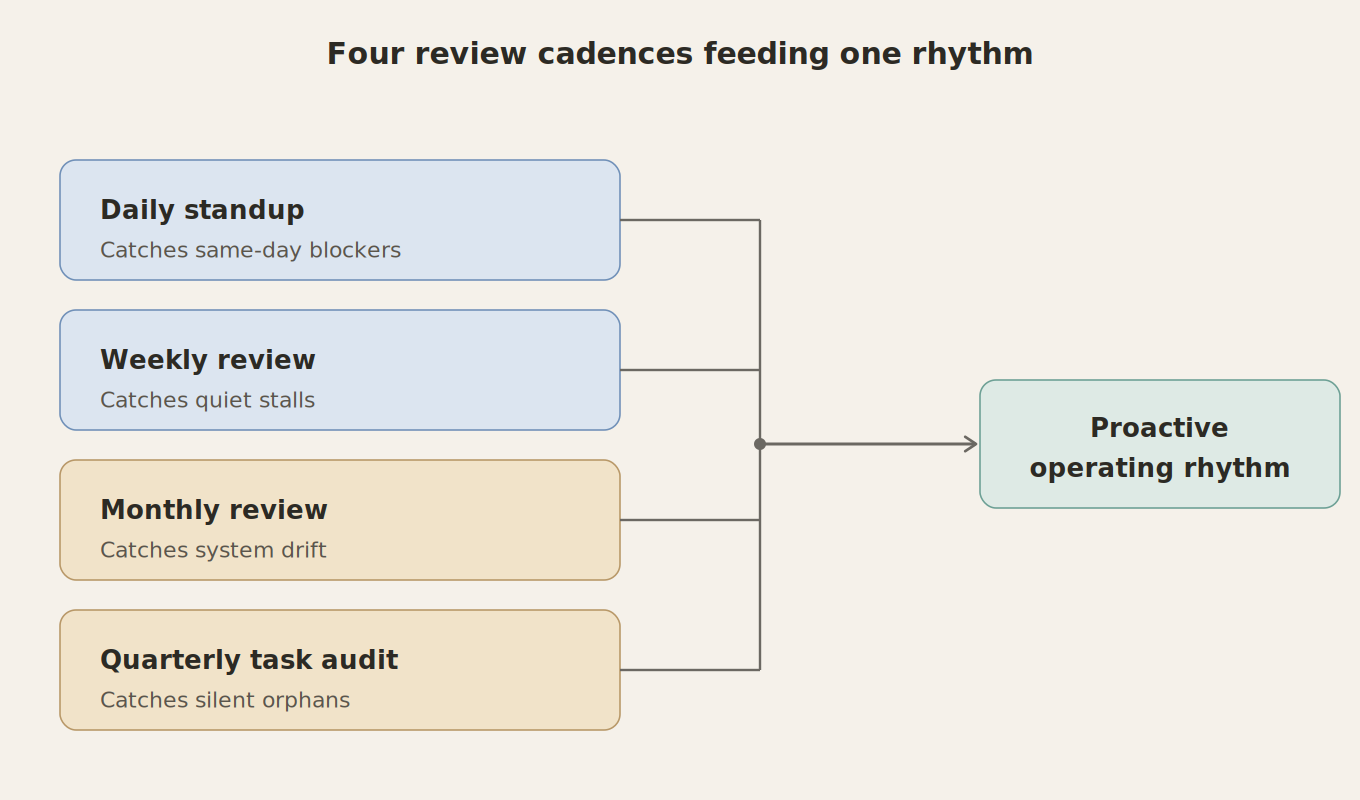
Status update rituals, such as a brief daily standup or a structured weekly review, keep obligations visible. Tasks rarely stall dramatically; they stall quietly. A weekly review surfaces the quiet stall before it becomes a missed deadline.
The cultural goal is a team in which raising a hand early about a task at risk is rewarded, not punished. The moment people learn to hide slipping work, the system is finished.
How do I use reminders, alerts, and deadlines to maintain consistent visibility?
Automated reminders are not a productivity nicety. They are the mechanism by which deadlines stop relying on memory.
Configure your task management system so that owners receive alerts in advance of deadlines, not on the day. Lead time gives recovery options; same-day alerts give only apologies.
Set a deadline on every task. Internal tasks too. The unwritten assumption that internal commitments are flexible is precisely how they slip indefinitely while client-facing work consumes all the attention.
Use escalation alerts. When a task passes its deadline without being closed or updated, the system should surface it automatically to the relevant manager. Escalation should not depend on anyone noticing.
Integrate the task system with the calendar. A unified view of meetings and commitments prevents the common failure mode of accepting a meeting that collides with focused execution time, then missing both.
For cyclical obligations such as VAT returns, insurance renewals, quarterly reviews, and contract anniversaries, recurring reminders are essential. These tasks are forgotten not because they are unimportant but because they appear too rarely to enter habit.
How do I prioritise tasks strategically to protect what matters most?
Two frameworks earn their keep.
The Eisenhower Matrix sorts tasks by urgency and importance, exposing the chronic problem that urgent-but-unimportant work consistently displaces important-but-not-yet-urgent work.
The MoSCoW method (Must, Should, Could, Won't) is sharper for scoping decisions, particularly within projects where competing demands need explicit ranking rather than implicit drift.
A daily or weekly planning ritual is where prioritisation becomes operational. Reviewing all active tasks, reassigning priorities based on current reality, and explicitly surfacing anything at risk converts prioritisation from an idea into a practice.
Protect high-priority work through time-blocking. Calendar discipline is what stops the most important task of the week being eaten by reactive demands. If the work isn't scheduled, it won't happen. Will power doesn't scale.
When team members have competing priorities, the resolution must come from leadership, not be left to the individuals to negotiate. Unresolved priority conflicts cause important work to stall while everyone waits for clarity that never arrives.
A project management tool should give you a live, prioritised view of every commitment the business is carrying. If you cannot see it at a glance, neither can your team.
How do I create workflows and systems that scale with my business?
Workflows must be designed with task tracking built in, not bolted on. Every stage of the process, from proposal through kick-off, delivery, handover, and invoice, should have task ownership and accountability defined as part of the workflow itself, not added retrospectively when something goes wrong.
Document and standardise workflows so the business doesn't depend on any single person's habits or memory. The test is straightforward: if your most reliable team member went on holiday for a month, would the work still run cleanly? If not, the workflow lives in their head, not in the business.
Automation reduces human error meaningfully. Auto-assigning tasks based on workflow stage, triggering reminders, updating statuses based on completed actions, generating recurring tasks: each piece of automation removes one opportunity for oversight.
Review your systems regularly. A task management infrastructure that worked at twenty staff may strain at forty. Scaling is not a single event but a continuous adjustment.
Onboard new team members into the system and the accountability culture from day one. New hires are the most common source of new gaps; embedding them in the existing discipline immediately prevents the slow drift back toward informal coordination.
How do I conduct regular reviews to catch what slips through?
Weekly and monthly reviews are the safety net beneath the system. Weekly reviews surface stalled tasks, forgotten owners, and emerging risks. Monthly reviews step further back and ask whether the system itself is still fit for purpose.
An effective task review meeting is short, structured, and explicitly not a blame exercise. The question is not who failed but what slipped, why, and what changes. Teams that learn to surface problems candidly catch things weeks earlier than teams who feel review meetings are inquisitions.
Status dashboards within the project management tool provide instant visibility across all active work. A well-configured dashboard answers, in one screen, the question every leader asks: what is the health of everything we're doing right now?
A periodic task audit, meaning a deep review of every open commitment, not just the visible ones, catches the silent drop. Tasks that have been quietly orphaned, deprioritised without anyone deciding to deprioritise them, or duplicated across systems surface only under this kind of scrutiny.
Consistent review habits are what convert task management from reactive firefighting into a proactive operating rhythm. This is the point at which Elite Project Consulting's engagements typically end: the business is no longer dependent on us, because the structure is now embedded in how the team works.
Bringing It All Together
Tasks falling through the cracks is rarely a people problem. It is almost always a structure problem in a business that has outgrown the way it used to coordinate work. The good news is that structure is buildable. The work is not glamorous (owners, deadlines, reviews, checklists, escalation) but the cumulative effect is a business that runs predictably, a team that delivers reliably, and a leader who can step out of delivery and back into leading.
At Elite Project Consulting, this is the work. We bring fractional project management structure to MDs and founders carrying too much, stabilise what is in flight, and leave the team with the systems and habits to run it themselves. The goal is never dependency on us. It is a business that no longer needs the workaround.
If you recognised yourself in the patterns described here, the next step is a conversation about what is actually in flight in your business and where the gaps sit.
Book a discovery call. No preparation needed beyond a willingness to describe the situation honestly.
FAQ
-
Work execution assurance is the discipline of knowing, at any moment, that everything the business has committed to is owned, tracked, and on course. It matters because confidence in delivery is the foundation of client trust, team performance, and the leader's ability to step out of the weeds and lead.
-
A task manager only works if every commitment enters it, every entry has a named owner and deadline, and the team uses it consistently. Tasks slip when the tool is partially adopted, when work still lives across email and chat, or when leadership doesn't model the behaviour they expect.
-
Most businesses cross the threshold somewhere between fifteen and forty staff, or when concurrent initiatives multiply faster than informal coordination can hold. If the MD or founder is spending more than a day a week managing project work, the threshold has already been crossed.
-
A task management system tracks individual action items: what needs doing, by whom, by when. A project management tool does that plus dependencies, milestones, resources, and reporting across multiple workstreams. Smaller businesses often start with the former and graduate to the latter as complexity grows.
-
A task gap analysis is a structured exercise comparing everything the business has committed to against everything that is genuinely tracked and executed. The distance between the two is where tasks fall through the cracks, and quantifying it is the first step to closing it.
-
A light weekly review and a deeper monthly review cover most needs. A full task audit, opening every commitment, verifying ownership, confirming status, is worth doing quarterly, or whenever growth, a key departure, or a delivery failure suggests the system has drifted.
-
Shared responsibility produces diffused accountability; every individual assumes someone else is acting. A named owner has nowhere to look but at themselves, which is the only condition under which a task is genuinely held.
-
Centralise every commitment into one tool, assign a named owner and deadline to every item, and run a fifteen-minute weekly review. Most of the value of a full system comes from these three habits alone.