

How Do I Deliver More Without Hiring More People?
Strategies, Systems, and Tools to Maximise Output Without Expanding Your Headcount
For most MDs and founders, the question isn't whether the team is working hard. It's why working hard isn't translating into more delivery. Hiring looks like the obvious answer until the maths starts working against you; longer ramp times, more coordination overhead, more management load on someone already stretched. The businesses that pull ahead don't always hire faster. They learn to deliver more from the people they already have by fixing the structure underneath them. At Elite Project Consulting, we've spent years inside businesses where the team was capable but the system around them wasn't. The patterns repeat. So do the fixes.
Understanding Your Current Delivery Capacity
How Do I Diagnose Where Time and Resources Are Being Lost?
You can't fix what you can't see. Shadow a real piece of delivery from intake to sign-off and note every handover, approval, wait state, and duplicated input. The gap between perceived process and actual process is almost always where the lost hours live. Map the full delivery cycle on a single page. Look for steps that exist because someone added them years ago and nobody questioned them, and for manual data entry bridging two systems that should be talking. Then measure actual output per team member against the realistic ceiling of their role. The tasks that consume disproportionate time relative to the value they create are your first targets, and most are invisible until someone takes the time to look.
How Do I Identify the Bottlenecks Limiting My Team's Throughput?
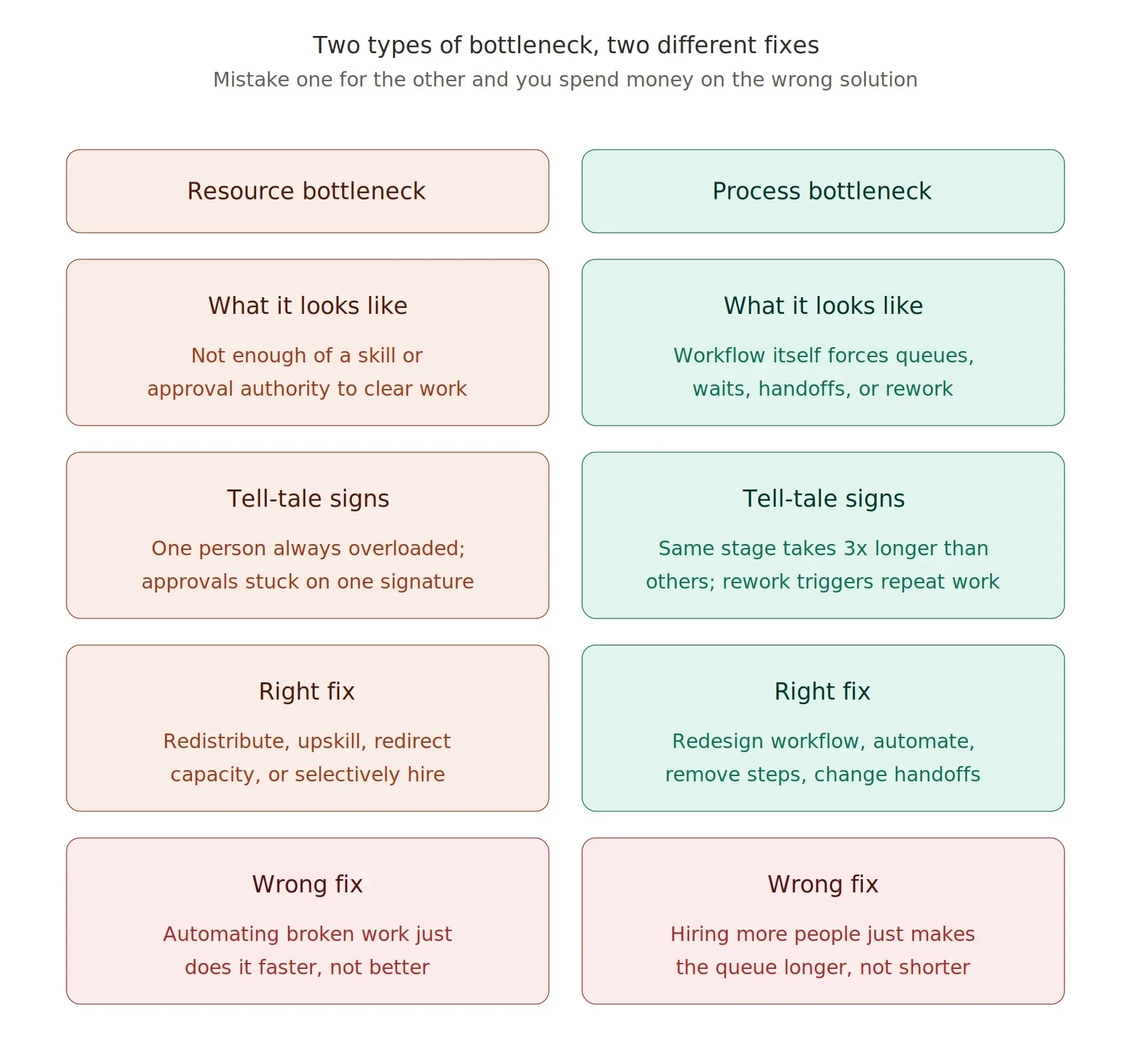
Bottlenecks come in two forms. Resource bottlenecks are where work piles up because there isn't enough of a particular skill or approval authority to clear it.
Process bottlenecks are where the workflow itself forces queues, waits, or rework. They look identical on the surface but need different fixes. Throwing people at a process bottleneck just creates more queue. Use cycle time per stage as your quantitative signal: if one stage consistently takes three times longer than the others, that's your constraint. Use team feedback as the qualitative one. Prioritise bottlenecks closest to the end of the delivery chain first, because fixing an early-stage one just pushes work into a downstream one that wasn't ready for it.
How Do I Establish a Baseline Before I Start Changing Things?
Without a baseline, you can't prove anything got better. Capture three or four Key Perfomrance Indicators (KPIs) that reflect delivery capacity (cycle time, weekly throughput, on-time delivery percentage, rework rate), before you change anything.
This baseline also forces a critical diagnostic: is it a people problem or a systems problem?
A people problem produces inconsistent output across the team for similar work.
A systems problem produces consistent friction across everyone, regardless of capability.
Get it wrong and you'll spend money fixing the wrong thing.
Streamlining and Automating Your Core Processes
How Do I Redesign My Workflows for Lean, High-Output Delivery?
Lean isn't working faster. It's removing the steps that don't add value so the rest moves cleanly. For every step, ask whether it directly contributes to what the client receives. Anything that fails that test is waste, even if it's familiar, even if someone defends it. Especially if someone defends it. Once the waste is stripped out, standardise what remains. Repeatable tasks should have a documented template so decisions don't get re-made every time. Decision fatigue is one of the most underestimated drains on daily output, and templates kill it at source.
How Do I Implement Workflow Automation to Replace Manual Work?
Workflow automation handles the predictable, rules-based, repetitive parts of delivery: moving information, triggering notifications, routing approvals, creating records. It does not handle judgement. The candidates are easy to spot: anything done the same way every time, anything that copies information between systems, anything that triggers a predictable next action. Status updates, onboarding checklists, document generation, follow-up sequences, escalations. Beyond throughput, automation reduces error rates, because the most common errors are the ones humans make on tasks they've done so many times they've stopped paying attention.
How Can AI Tools Multiply What My Existing Team Can Deliver?
AI is the most significant capacity multiplier most businesses have ever had access to, and most are barely using it. First drafts of content, document summaries, structured analysis of unstructured data, meeting transcription, client communications, reporting commentary: all jobs AI now does in minutes that used to take hours. The integration matters as much as the tool. AI dropped into a workflow as a novelty produces a novelty's value. AI embedded into the steps people actually do every day produces compound returns. Evaluate on speed and quality, not hype.
Building the Right Technology Infrastructure
How Do I Choose the Right Software Stack to Support More Delivery?
The right stack isn't the biggest stack. It's the one that fits how the business works and grows with it. Evaluate tools on three criteria: does it scale, does it integrate cleanly with what you already use, and is it simple enough that the team will actually use it. Tool sprawl is one of the most common silent killers of delivery capacity. Each new platform fragments information and creates more places where work can hide. Before adding anything, ask whether an existing tool already does it.
How Do Project Management Tools Help My Team Deliver More?
The right project / work management platform replaces three things that quietly absorb enormous capacity: status meetings, chasing emails, and the search for the latest version of anything. Visibility means leaders see where work stands without convening anyone. Accountability becomes structural, because the system shows who owns what, by when, and whether it's at risk. Prioritise dependency mapping, capacity views, customisable workflows, and reporting that surfaces what's stuck. Avoid platforms that need a specialist to administer; the team will quietly stop updating them. Our work with platforms like Asana and Smartsheet consistently shows the productivity gain comes less from the tool itself and more from finally having one place where the truth lives.
How Does Cloud Technology Enable Me to Scale Delivery?
Cloud infrastructure removes the operational ceiling on-premise systems used to impose. Storage, processing, and access scale with demand, not capital expenditure. Real-time collaboration means the team works on the same document without version conflicts. Distributed teams become a strategic advantage, because talent isn't restricted by geography. The overhead saved goes back into delivery.
How Do I Use Communication Tools to Cut Coordination Waste?
Poorly managed communication is one of the most expensive forms of capacity drain in modern businesses. Constant context-switching destroys deep work; notification overload trains the team to react rather than produce. Asynchronous communication should be the default. Most things don't need a meeting; most don't need an immediate reply. Set clear channel rules and integrate communication tools with project management platforms so updates flow into the right place automatically rather than scattering across DMs.
Optimising How Your Team Works
How Do I Focus My Team's Effort on the Highest-Impact Priorities?
Most teams don't lack effort. They lack a priority framework. When everything is important, nothing is, and the work that gets done is whichever piece is loudest, not whichever matters most. Implement a simple structure (must-do this week, must-do this month, strategically important but not yet urgent) and enforce it visibly. Leadership decisions about what comes off the list are as important as decisions about what goes on. Saying no protects capacity for the things that need a yes.
How Do I Upskill My Existing Team to Expand What They Can Deliver?
Targeted upskilling is one of the fastest, cheapest ways to expand capacity. A team member who can independently complete a task that previously needed two people has just expanded throughput without a penny on recruitment. The trick is identifying the specific skill gaps actually limiting delivery, not running broad training programmes. Build training around real work. Pair newer team members with experienced ones on live deliverables, and document the institutional knowledge that lives in people's heads.
How Do I Improve Resource Management to Stop Underutilising My Team?
Resource management based on assumptions produces uneven workloads, with some people permanently swamped and others quietly underutilised. Allocate work based on actual data: who's loaded with what, what's coming, where the gaps are. Look at who's underutilised and why. It's rarely effort; it's usually visibility. Redirecting that capacity is one of the quickest wins available. A team running consistently at one hundred and twenty per cent doesn't deliver more. It delivers less, slower, with more rework.
How Do I Reduce the Meetings and Admin Stealing My Team's Time?
Quantify it first. Add up combined meeting hours plus the admin around them. For most management teams it's close to a full working day per person. Cut meeting frequency by half as a starting point. Halve durations again. Require an agenda or cancel. Replace recurring status meetings with automated reporting and asynchronous updates. Every hour returned to delivery is an hour the business didn't have to hire for.
Scaling Delivery Through Strategic External Leverage
When Should I Outsource Tasks Instead of Hiring or Doing Them Internally?
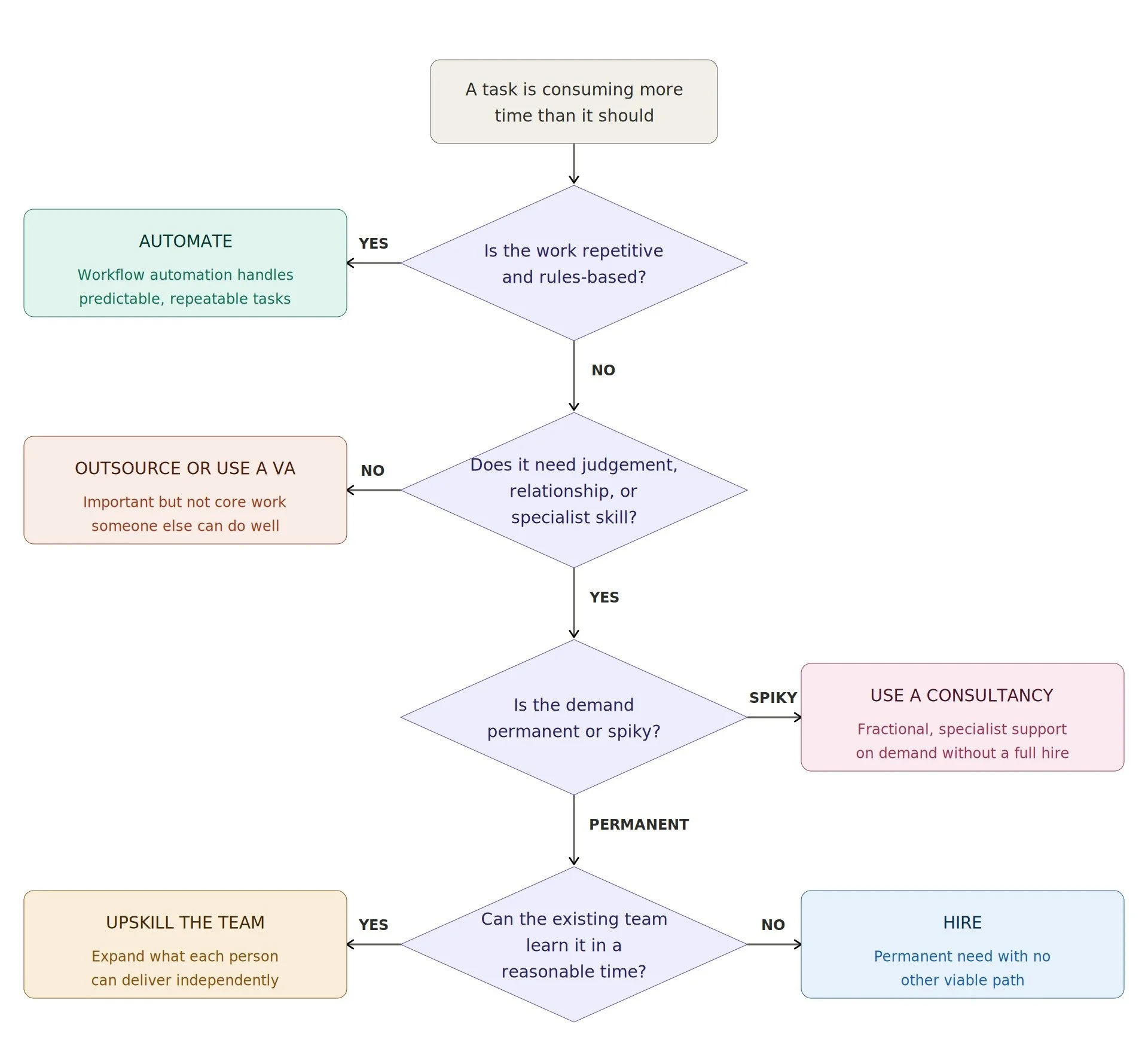
Outsourcing works best for work that's important but not core: things that need to be done well but don't need to be done by you. Bookkeeping, payroll, IT support, design production, technical specialisms used occasionally, project management. Protect internal capacity for work that requires your team's knowledge of your business. Manage outsourced work like internal work: clear briefs, defined deliverables, regular reviews. A cheap relationship that creates coordination overhead is more expensive than a slightly pricier one that runs itself.
When Should I Use a Consultancy to Expand Delivery?
Consultancy partnerships make sense when you need specialist capability on demand without building it in-house, or when delivery volume spikes beyond what the internal team can absorb. Structure the relationship carefully. Define what's yours, what's theirs, how handovers work, how quality is assured. Build internal capability instead when demand is permanent rather than spiky, when the work is too sensitive to externalise, or when the consultancy margin makes the maths worse than hiring.
How Do I Create Scalable Delivery Models Through Platforms and Systems?
Platform-based delivery is the difference between a service business that scales linearly with headcount and one that scales exponentially with systems. When work is systematised (standardised, automated, monitored) the labour required per unit of output falls. Businesses with weak systems hire to grow. Businesses with strong systems grow without proportional hiring, because the systems carry the load. Turning ad hoc delivery into a repeatable model is exactly the kind of work Elite Project Consulting embeds with clients.
Measuring and Continuously Improving Delivery Performance
How Do I Use Analytics Tools to Improve Delivery Efficiency Over Time?
Once a baseline exists, analytics become the engine of improvement. The metrics that matter (cycle time, throughput, on-time delivery, rework rate, utilisation) should be visible in real time, not pulled together quarterly. Dashboards make the invisible visible: small inefficiencies that don't show up in any single piece of work but accumulate to significant lost capacity across the month. Use the data to make decisions, not to admire it. The point of measurement isn't reporting; it's earlier, better intervention.
How Do I Build a Culture of Continuous Process Improvement?
Major overhauls are expensive and disruptive. Small, continuous improvements compound. Establish a regular review cycle (monthly works for most businesses) where the team surfaces what's slowing them down. The people closest to the work usually know exactly where the friction is. They've just never been asked or given the authority to fix it. A culture where every team member is empowered to spot and remove friction outperforms any one-off transformation project.
Why Is Scaling Delivery Capacity the Real Long-Term Growth Strategy?
The ability to deliver more without hiring more is one of the most durable competitive advantages a business can build. It improves margins, reduces dependency on any single individual, and makes growth predictable rather than chaotic. New revenue lands as profit rather than as more cost. The businesses we work with that scale most sustainably invest in the operating model before they need to. That's the long game, and it's the work Elite Project Consulting exists to do alongside leaders who are ready to play it.
The Bottom Line
Delivering more without hiring more isn't a productivity hack. It's a way of running a business, one where the structure underneath the team carries weight that informal coordination can't, and where every hour of capacity goes towards the work that matters most. The businesses that master it grow more profitably, scale more sustainably, and depend less on the heroics of any individual.
At Elite Project Consulting, this is the work we do every day, bringing structure, systems, and senior project leadership to MDs and founders who have too much in flight and not enough scaffolding underneath it. We embed, we deliver, and we leave the team stronger than we found it.
If you're carrying more delivery than your current setup can hold, the next sensible step is a conversation. Book a discovery call and we'll work out, together, what would actually move the needle in your business.