

Do I Need New Software, or Do I Need a Project Manager?
It's the question that lands on most operational leaders' desks at least once a year. Projects are slipping, teams are frustrated, deadlines are quietly negotiated downwards, and someone, somewhere, is asking whether the answer is a new tool or a new hire. At Elite Project Consulting, we hear this question constantly, and the honest answer is rarely as simple as the question implies. The decision is consequential, often expensive, and frequently made for the wrong reasons.
This guide walks through how to diagnose what's actually broken, what each solution can fix, and how to make a decision you won't regret six months later.
Understanding the Core Problem Before Choosing a Solution
How do you diagnose the real source of project failures?
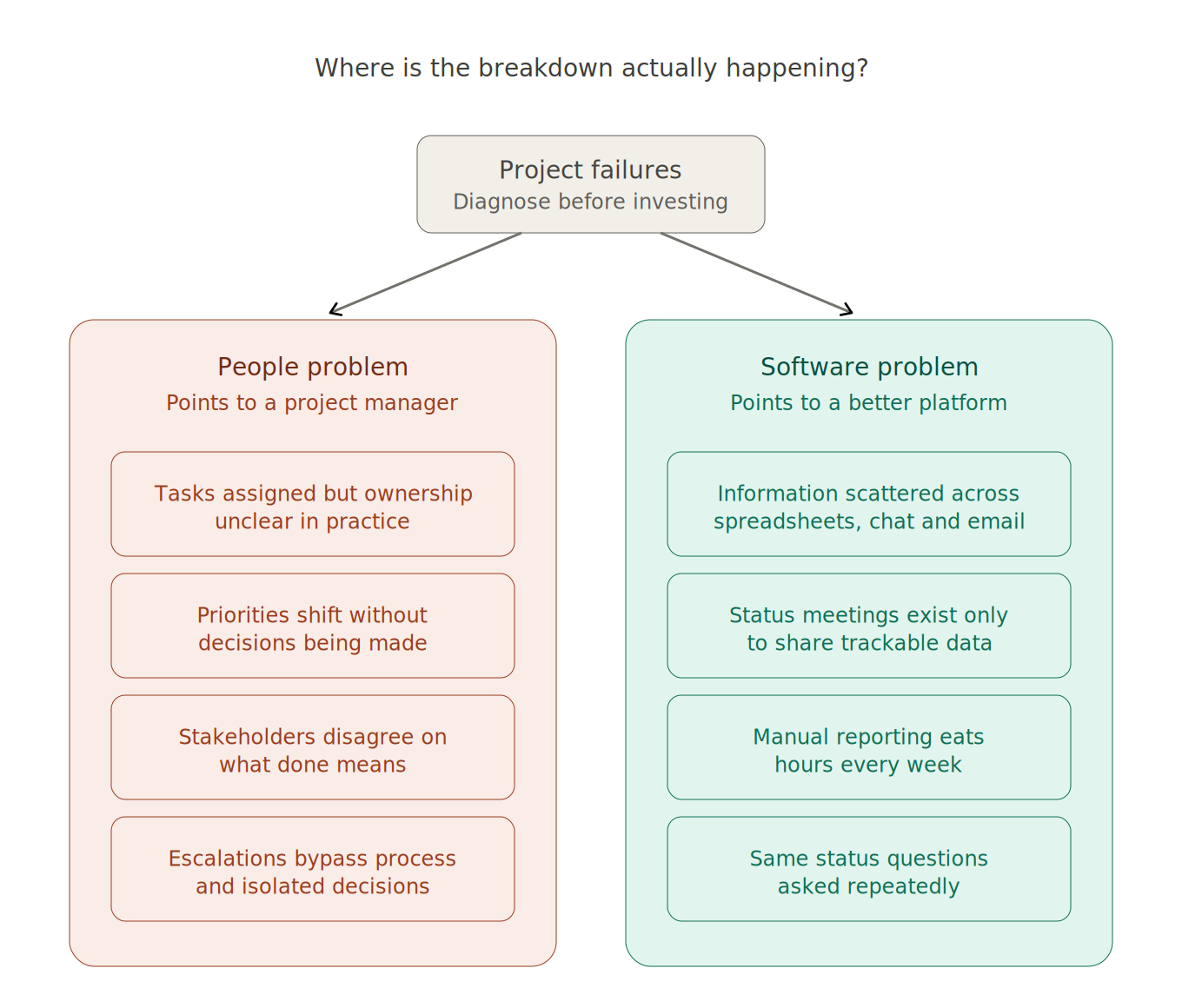
Before you spend a penny on software or salary, you need to know what you're actually solving. Project failures rarely have a single cause, but they almost always have a centre of gravity, and that centre is either human or systemic.
A human-centred failure looks like this: tasks are visible, deadlines are documented, the platform is doing its job, but nobody is driving decisions. Priorities shift mid-week without explanation. Stakeholders disagree about what "done" means. Resources are assigned but not held accountable. The information exists; nobody is acting on it.
A systemic failure looks different. Your team is capable and motivated, but they're chasing information across email threads, spreadsheets, and three different chat tools. Status updates are duplicated. Nothing is the single source of truth. People are coordinating well, they just can't see what's happening.
Common signals of a people problem include repeated missed handoffs despite documentation, unclear ownership on tasks that are assigned in the system, escalations that bypass process and stakeholders making decisions in isolation. Signals of a software problem include version-control chaos, status meetings that exist only to share data the tool should surface automatically, manual reporting that consumes hours each week, and integration gaps between platforms.
Misdiagnosing the root cause is the most expensive mistake a leadership team can make here. Buying software to solve a leadership vacuum results in an expensive subscription nobody uses. Hiring a project manager to compensate for 'tool sprawl' burns out a good professional on administrative work. Tool-first thinking, the assumption that the right platform will produce the right behaviour, has cost organisations more in failed implementations than almost any other operational misstep.
What can project management software actually fix, and what can't it?
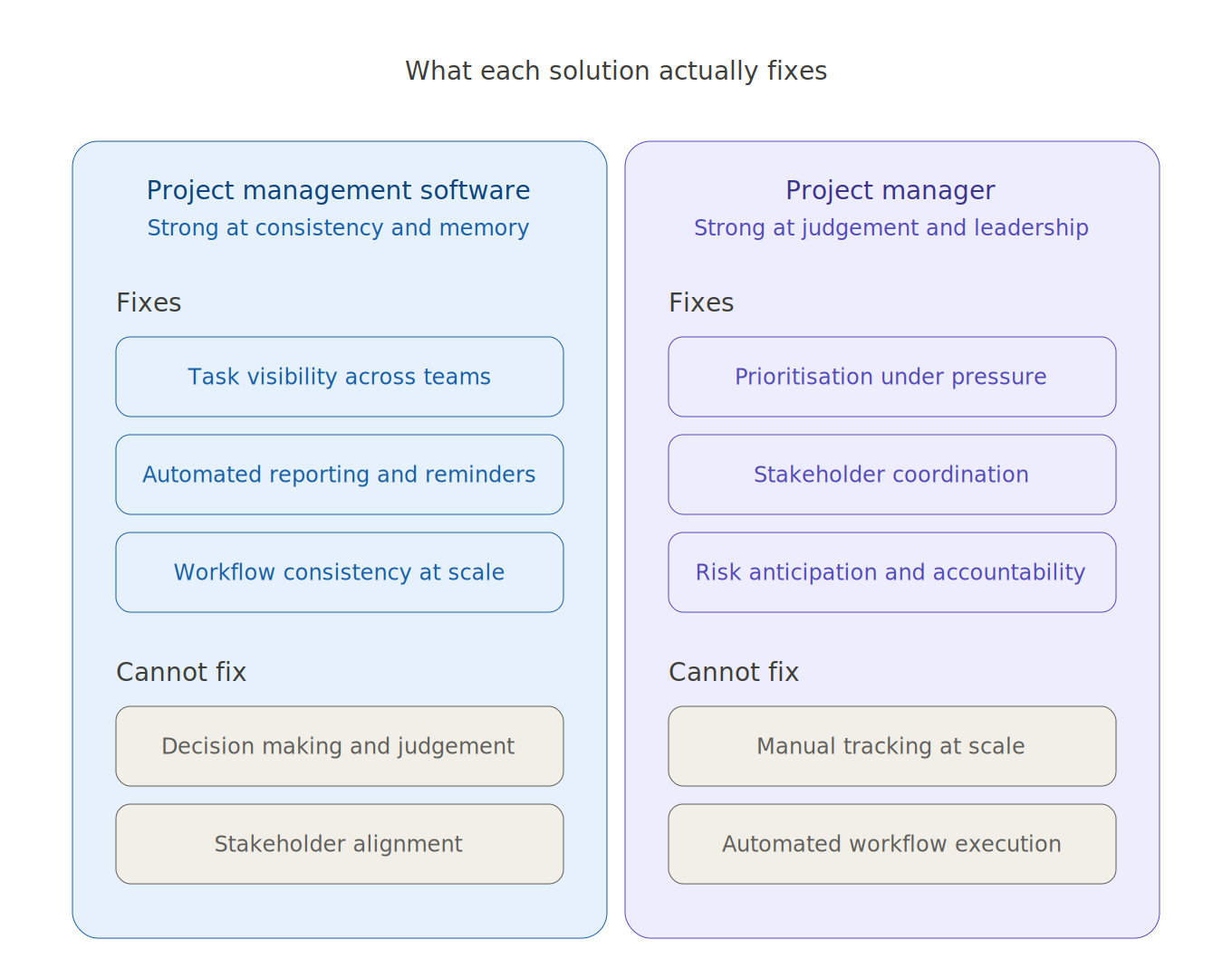
Software is exceptional at the things humans are bad at: consistency, visibility, repetition, and memory. A well-chosen platform will give you task transparency across teams, automated scheduling and reminders, structured workflows that don't degrade under pressure, real-time reporting, and a durable record of what happened and when. These are real, measurable gains.
What software cannot do is decide. It will not resolve a disagreement between two department heads. It will not chase a stakeholder who's gone quiet on a critical sign-off. It will not notice that a project's underlying business case has shifted. It cannot read the room in a steering committee meeting, nor can it tell you which of three competing priorities should win this week.
The myth that better tools automatically produce better outcomes is one of the most persistent in operational thinking. When new software is layered onto undefined responsibilities, it tends to amplify the existing dysfunction rather than resolve it. You now have visible chaos.
What can a project manager actually fix, and what can't they?
A skilled project manager brings what software fundamentally cannot: judgement, leadership, and human coordination. They allocate resources based on context that no algorithm can fully capture. They manage risk by anticipating what isn't yet in the data. They hold people accountable in ways that a Slack notification never will. They translate strategic intent into operational execution.
However, a project manager cannot replace systems. Asking one person to manually track twenty workstreams, send reminders, compile reports, and maintain documentation across an organisation is asking them to be human middleware, and the moment they take leave, the entire structure collapses. A project manager without proper tooling becomes a bottleneck rather than a multiplier.
We've seen capable project managers lose their effectiveness within months of being hired into tool-poor environments, simply because their time is consumed by administrative tracking the right platform would handle automatically.
How do you map your organisation's current state before deciding?
Before choosing a path, audit what you have. List every tool currently in use for project work, including the unofficial ones: the spreadsheets, the shared documents, the chat channels that have become de facto status boards. Note which are actively used and which are theoretically used. Underutilised software is often mistaken for inadequate software; the issue may be training, configuration, or ownership rather than capability.
Then assess your team. How many concurrent projects are running? How complex is the stakeholder map? Who owns what, and is that ownership documented? What's the typical lifecycle of a project from initiation to close, and where does it usually break down?
Honest answers to these questions, what's working, what isn't, where the friction lives, are the foundation of a sound decision. Skipping this step is how organisations end up solving the wrong problem at significant cost.
Evaluating Software vs a Project Manager Against Your Specific Needs
When is new project management software the right answer?
Software is the right investment when your team coordinates well but lacks structure. The signals are specific: your people communicate effectively, ownership is generally clear, leadership is engaged, but information lives in too many places, manual reporting eats meaningful time each week, and the same status questions get asked repeatedly because there's no shared view.
The right platform addresses scalability, automation, and integration. It turns repeated manual coordination into background process. It gives leadership real-time visibility without requiring anyone to compile reports. For organisations growing past the point where informal coordination scales, software is often the lower-cost, higher-leverage answer compared to adding headcount.
Cost comparison matters here. A capable project management platform such as Asana or Smartsheet, might cost a few thousand pounds annually per team, once initially set up. A senior project manager, fully loaded, will typically cost between £60,000 and £100,000 in the UK depending on sector and seniority. Software wins on cost when the underlying problem is genuinely about systems rather than leadership.
How should you approach the software selection and evaluation process?
Selecting a platform is where most organisations go wrong. They start with features and trending tools rather than with their own operational requirements. The order should be reversed.
Begin by mapping your actual workflows, not idealised ones, but how work currently moves through your business. Identify the points of friction. Then evaluate platforms against those specific requirements: does it handle your dependency model, your reporting needs, your integration requirements with existing finance, CRM, or communication tools?
Scalability is often underweighted. A platform that suits a team of twelve may collapse at sixty. Conversely, an enterprise-grade tool deployed into a small team typically generates adoption resistance that kills the implementation. At Elite Project Consulting, we provide support and align with the organisation's actual maturity.
When is hiring a project manager the right answer?
A project manager is the right investment when your tools are adequate but accountability is missing. The signals: visibility exists in the system but nothing happens with it; meetings run long because no one drives them; stakeholders pull in different directions without resolution; strategic intent doesn't translate cleanly into operational delivery.
A project manager adds value through prioritisation, stakeholder management, risk anticipation, and the kind of cross-functional coordination that requires reading context, not just data. They convert ambiguous business goals into structured plans, and they hold the line on those plans when pressure mounts.
The investment is justified when project volume, organisational complexity, or stakeholder breadth exceeds what existing team leads can absorb alongside their other duties. If your operations manager, head of delivery, or department leads are spending more than a third of their time on project coordination, you're already paying for a project manager, just in the wrong currency.
How do you define the project manager's role within your business?
A common failure is hiring a project manager without clarifying scope. They arrive, find their responsibilities overlap with existing team leads, and either step on toes or shrink their remit until they're underused.
Clarify before you hire. Where does the project manager's authority begin and end? Which projects fall under their oversight? How do they interact with department heads who previously owned coordination? What tools will they use, and who owns the configuration of those tools?
Set measurable expectations from day one: timelines, budgets, deliverables, team performance against committed plans.
When do you actually need both?
For most growing organisations beyond a certain scale, the honest answer is both, but sequenced, not simultaneously.
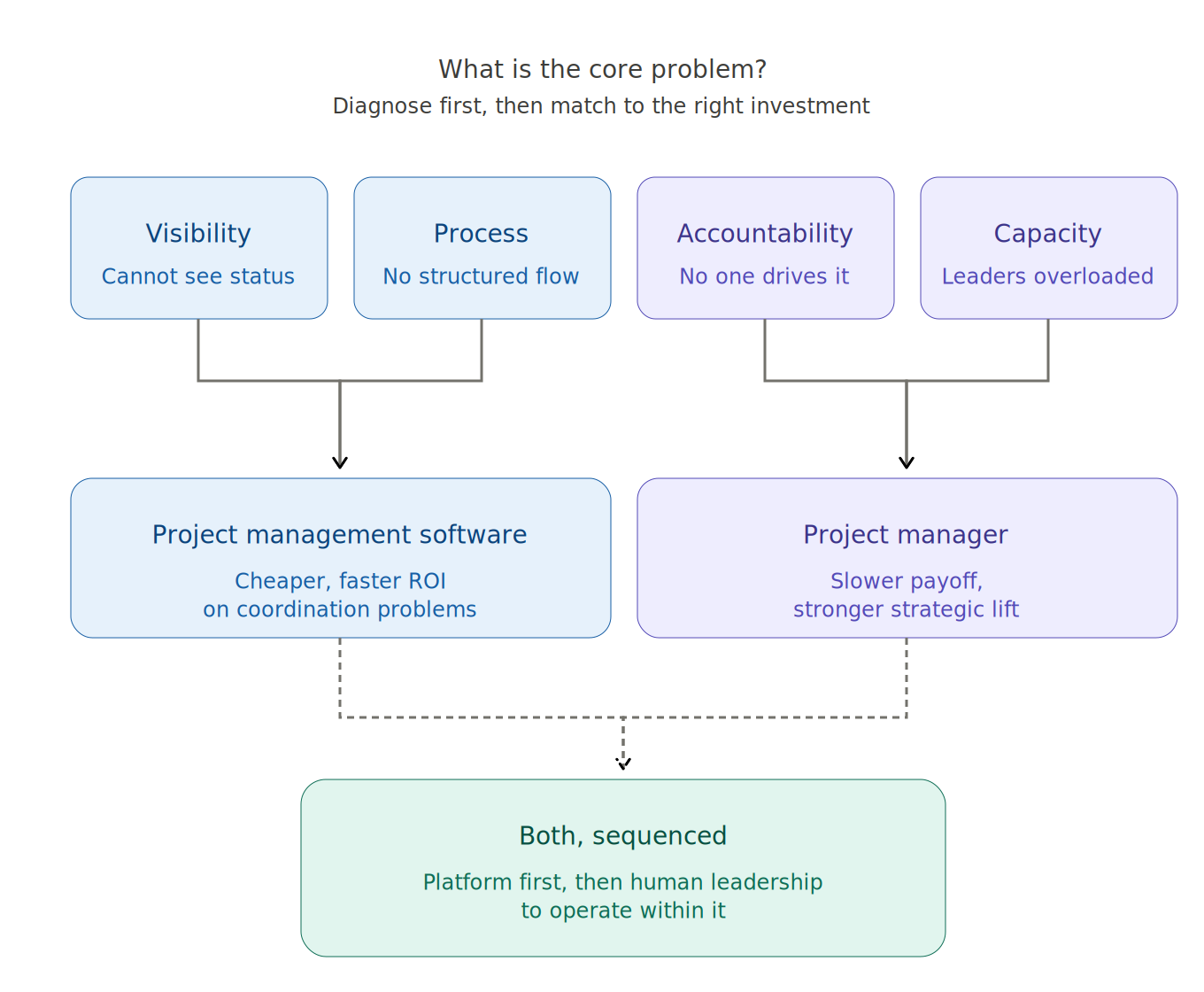
A project manager working without proper tooling spends their day on administrative tracking. Software running without human oversight produces detailed reports that nobody acts on. Together, the combination compounds: the platform handles consistency, visibility, and memory; the PM handles judgement, leadership, and coordination. Each amplifies the other.
The risk of investing in one without the other shows up within twelve months. The project manager burns out or leaves. The software falls into disuse and becomes another line item in the SaaS audit. They're almost always preventable with a sequenced investment plan; typically establishing the right platform first, then bringing in human leadership to operate within it.
How does team collaboration and communication factor into the decision?
Communication patterns are one of the clearest diagnostic signals available. If your team communicates well but information is scattered, you have a software gap. If information is centralised but nobody acts on it, you have a leadership gap. If both are broken, you have a cultural issue that neither solution will fix alone.
Pay attention to where communication breaks down. Is it at handoffs between teams? At escalation points? In status reporting? Each of these points to a different root cause and a different intervention.
Making the Decision and Implementing the Right Solution
What's a practical framework for making this decision?
Work through these diagnostic questions in order.
First: is the core problem visibility, accountability, capacity, or process? Visibility and process problems lean toward software. Accountability and capacity problems lean toward a project manager.
Second: involve your team. The people closest to the work usually know exactly what's broken, they often haven't been asked. Run a structured exercise where team members identify their top three friction points. Patterns will emerge quickly.
Third: stay objective. Leadership teams default to familiar solutions. A CTO will reach for software; a COO will reach for a hire. Resist that pull. Make the decision against the diagnosis, not against personal preference.
Finally, align the decision with where the business is heading, not only with where it hurts today. The right answer for a stable team of fifteen is different from the right answer for a team scaling to fifty in twelve months.
How do you budget and prioritise the investment?
Start by calculating the cost of the current inefficiency. How many hours per week are lost to manual reporting, missed handoffs, and rework? What's the cost of projects running late or over budget? This number is almost always larger than expected and provides the business case for either investment.
Compare ROI honestly. Software typically delivers faster, more measurable returns on coordination problems. A project manager delivers slower-realised but more strategic returns on leadership problems. Neither is universally better. Context determines which compounds faster in your specific environment.
Budget for the full cost of implementation, not just the headline figure. Software requires configuration, training, and change management. A new project manager requires onboarding, tooling, and time to build credibility. Underfunding implementation is the single most common reason these investments fail.
What should you consider when implementing either path?
Software rollout fails when it's treated as a procurement exercise rather than a change management one. Plan for phased adoption, identify internal champions, invest in proper training, and resist the temptation to migrate everything at once. Expect six months before you see steady-state benefit.
Onboarding a project manager fails when they're handed a remit and left to figure it out. Define their scope, give them executive backing for the first ninety days, and ensure they have the tools and access to do the job. The first projects under their oversight are credibility-building exercises. Set them up to succeed.
Measure success specifically.
For software: adoption rates, time saved on reporting, reduction in status meeting time, on-time delivery rates.
For a project manager: project completion against committed timelines and budgets, stakeholder satisfaction, team capacity utilisation.
Revisit the decision at six and twelve months. If the chosen solution isn't producing measurable improvement, the diagnosis was probably wrong, not the execution. Be willing to adjust.
Conclusion
The real question isn't software or project manager. It's what's actually broken and what your organisation will actually use. Tools without leadership become expensive databases. Leadership without tools becomes administrative burnout. The organisations that get this right diagnose carefully, sequence their investment, and resist the pull toward the solution they already prefer.
At Elite Project Consulting, this diagnostic work is where we spend the most time with clients, because the cost of getting this decision wrong, in budget and in momentum, dwarfs the cost of taking the time to get it right.
If you're weighing this decision now, the most valuable next step is rarely a software demo or a recruitment brief. It's an honest audit of where your projects are actually breaking down. We offer a structured diagnostic that gives you that clarity in weeks, not months, so when you do invest, you invest in the right thing.
FAQ
-
Project management software is a platform that handles task tracking, scheduling, reporting, and workflow automation. A project manager is a person who provides leadership, prioritisation, stakeholder coordination, and decision-making. Software handles consistency and visibility; a project manager handles judgement and accountability.
-
Most fail because they're treated as a procurement decision rather than a change initiative. Without proper configuration, training, executive sponsorship, and adoption strategy, even the best platform becomes shelfware within a year.
-
A mid-level project manager typically costs between £45,000 and £65,000 annually. A senior project manager or programme manager ranges from £65,000 to £100,000 or more, depending on sector and complexity.
-
Small businesses generally benefit from a dedicated project manager when they're running more than five concurrent projects, have multiple cross-functional stakeholders, or when senior leaders are spending over a third of their time on coordination rather than strategic work.
-
Low adoption rates, parallel tracking in spreadsheets or chat tools, manual report compilation despite platform availability, and team complaints about complexity all suggest the software either doesn't fit the workflow or wasn't implemented properly.
-
Yes, fractional project management is often the right interim step for organisations that need senior judgement but can't justify a full-time hire. It works best for defined projects, programmes or transitional periods rather than ongoing operational coordination.
-
Software typically shows measurable benefit within three to six months once adoption stabilises. A project manager usually delivers visible impact within one to two project cycles, often three to six months depending on project length.