

Why Do My Project Deadlines Keep Slipping?
If your projects keep finishing late, it's almost never because your team isn't working hard enough. Deadline slippage is a structural problem, not an effort problem. It happens when planning, scope, dependencies, communication and risk are managed informally rather than deliberately, and the cracks compound until the end date moves whether you want it to or not.
At Elite Project Consulting, working with founders and senior leaders, we see the same patterns repeat in industry after industry. The good news: the causes are well understood, and most of them are fixable without bureaucracy. This article walks through reasons deadlines slip, how execution failures accelerate that slippage and the practical methods that stop it.
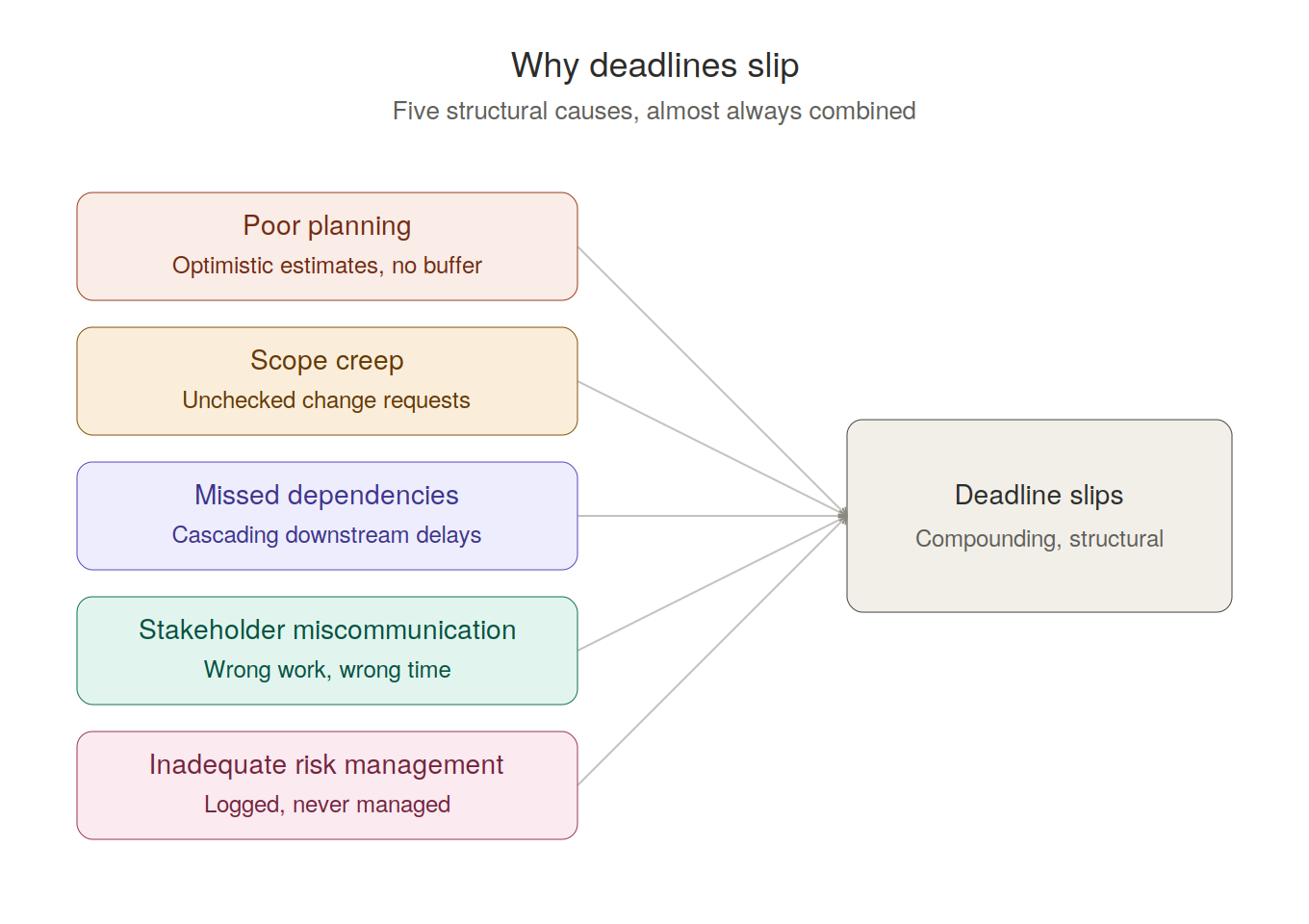
The Root Causes of Project Deadline Slippage
Poor Project Planning and Unrealistic Time Estimates
Most slippage is decided before the project starts. Inadequate upfront planning creates a fragile timeline from day one. It looks fine on paper but has no resilience to anything other than the perfect scenario. When something unexpected happens (and something always does), there's nothing in the plan to absorb it.
Underneath this sits the planning fallacy, a well-documented cognitive bias where teams systematically underestimate how long their own tasks will take, even when they've been burned by it before. People imagine the work going smoothly. They picture the focused hours, not the interruptions, sick days, dependency waits, or unexpected complexity. The estimate that comes out of that thought process is almost always optimistic.
Initial estimates also tend to be made against an idealised version of the work. They assume requirements are clear, stakeholders are aligned, and the people doing the work will be available full-time. None of those assumptions usually hold. When real-world complexity hits, including half-defined requirements, competing priorities, and a stakeholder who changes their mind in week three, the estimate breaks.
Missing or incomplete requirements at the planning stage are particularly damaging, because the cost shows up later. Work gets built against assumptions, those assumptions turn out to be wrong, and rework consumes time that was never planned for. Each round of rework pushes the deadline further out.
Skipping milestone definition makes this worse. Without checkpoints, there's no early warning system. Slippage stays invisible until the final deadline is in trouble, at which point it's far too late to recover.
Milestones are the project's pulse. Without them, you can't tell whether you're on track or quietly drifting.
Finally, plans built without buffer time leave zero room for the unexpected. A timeline that requires everything to go right will almost certainly go wrong. Buffer isn't padding or inefficiency. It's the recognition that real projects encounter friction, and the schedule has to be able to absorb it.
Scope Creep and Uncontrolled Change Requests
Scope creep is the gradual, unchecked expansion of what a project is supposed to deliver. Rarely does it arrive as a single dramatic change. It arrives as a sequence of small, reasonable-sounding additions, including a tweak here and a "while we're at it" there, none of which seem significant on their own. Added together, they push the deadline out by weeks or months, and nobody can quite point to where it happened.
The mechanism is usually informal. A stakeholder mentions something in a meeting. A developer agrees to "just add" a feature. An email goes out promising a small extra deliverable. None of these requests go through a formal change control process, so none of them get assessed for timeline impact before they're absorbed into the workload. By the time someone notices, the project is carrying a significant amount of work that was never in the original plan.
Poorly defined project requirements multiply this. When the scope was vague to begin with, every clarification feels like a discovery rather than a change, and the team accepts new work without recognising it as scope addition. The weaker the initial scope baseline, the more frequently and invisibly scope grows.
Stakeholders introduce new demands mid-project largely because they don't understand the timeline cost. From the outside, a small request looks small. They don't see the dependency reshuffling, the coordination overhead, the testing implications, or the displaced priorities. Without a structured way to surface those costs, they keep asking, and the team keeps absorbing.
Every scope addition also compounds coordination overhead. New work needs new conversations, new approvals, and new alignment between teams. Task sequencing gets disrupted. Critical path items get pushed. The slippage isn't proportional to the size of the change. It's amplified by the disruption the change causes around it.
Underestimated Project Dependencies
Dependencies are the invisible scaffolding of a project. When they're well mapped, work flows. When they're missed or poorly understood, a single blockage can stall everything downstream.
Unidentified dependencies are the most dangerous, because by the time you discover them, you're already stuck. A piece of work can't start until another piece is finished, but nobody noticed the link until the team hit the wall. The schedule was built assuming parallel execution; in reality, the work is sequential. Days or weeks get lost reorganising around the truth of the dependency structure.
External dependencies are particularly hard to control. Third-party vendors, regulatory approvals, supplier deliveries: none of these respond to your project timeline. They run on their own. Teams routinely underestimate how much of their schedule sits in someone else's hands, and how little leverage they have to accelerate it when it slips.
Cross-functional dependencies inside the business carry their own coordination overhead. Getting four teams to align on a hand-off looks simple on a Gantt chart. In practice it requires meetings, clarifications, prioritisation conversations, and ongoing follow-up. Teams underestimate the management work required just to keep the dependencies moving.
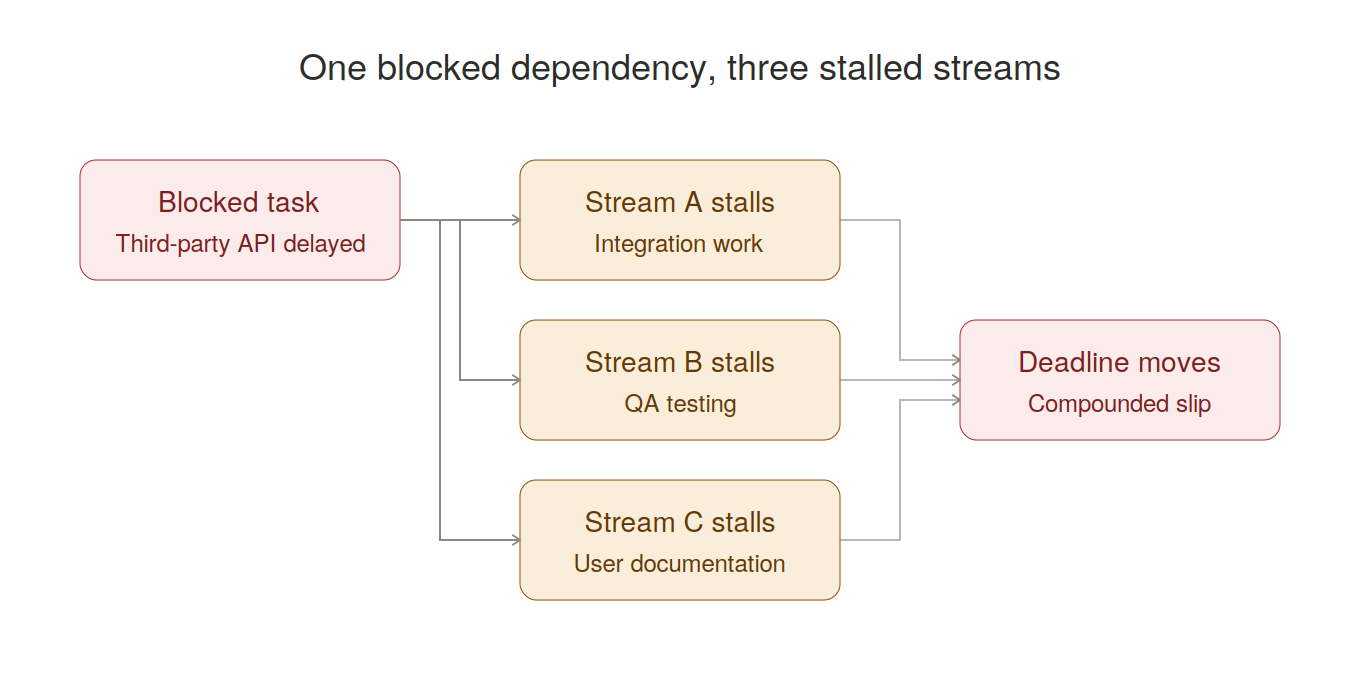
Because dependencies fan out, a single blocked one can stall multiple workstreams at once. A delayed input to one team becomes a delayed input to three teams downstream. The slippage cascades, and the further into the project it happens, the harder it is to recover.
Stakeholder Mismanagement and Miscommunication
Stakeholders shape the deadline whether you let them or not. Manage that relationship deliberately and the project moves. Manage it informally and you lose control of the timeline by accident.
Unclear communication of project priorities is one of the most common causes. When the team doesn't have an explicit, shared understanding of what matters most, people work on the wrong things at the wrong time. They focus on visible tasks instead of critical ones. They polish details on work that isn't on the critical path while genuinely urgent items wait. The hours get spent, but the deadline still slips.
Misaligned stakeholder expectations are equally damaging. If the sponsor thinks the project will deliver one thing and the team is building another, the reckoning is just deferred, and the closer it happens to the deadline, the more expensive the correction. Alignment isn't a one-off conversation at kickoff; it has to be revisited as the project evolves.
Infrequent or ineffective status reporting allows slippage to go unnoticed until it's already critical. If the status update is a five-minute summary in a busy meeting, the nuance gets lost. Risks don't get flagged. Slippage gets softened in the telling. By the time the picture is clear, the runway to fix it is gone.
Miscommunication between teams creates duplicated effort, rework and delay. Two teams unknowingly working on the same thing. One team waiting for an input the other doesn't know it owes. A decision made in one room that contradicts a decision made in another. Every one of these moments costs days, and most of them are entirely avoidable with deliberate communication structure.
Inadequate Risk Management
Most projects have a risk register. Few projects have a living risk register. The difference is the difference between identifying risks and actually managing them.
Risks get logged at the start of the project and then quietly ignored. Nobody owns them. Nobody reviews them. The document sits in a folder while the risks themselves materialise and turn into delays. Identification without active tracking is, in practice, no risk management at all.
Without a formal risk register that's actively used, obstacles and roadblocks become full-blown delays before anyone has a chance to mitigate them. The early warning function, which is the whole point of risk management, never fires. The team finds itself dealing with an emergency that, in hindsight, was entirely foreseeable.
Risks also evolve. The risk profile at week one is not the risk profile at week ten. New threats emerge as the project unfolds: a key person hands in their notice, a dependency partner changes their roadmap, a regulatory consultation opens. Teams that don't reassess risk regularly are managing yesterday's project.
Underestimating the probability and impact of risks leads to no contingency planning. If you treat a risk as low-impact, you don't build a Plan B. When the risk hits and turns out to be high-impact, the project has no fallback, and the timeline takes the full weight.
How Project Execution Failures Accelerate Deadline Slippage
Planning failures set the stage for slippage. Execution failures accelerate it. Even projects that were planned well can lose weeks through how they're run day to day.
Resource Constraints and Staffing Gaps
Resource allocation mismatches are one of the most direct causes of delay. Assign too few people to a workstream and the maths simply doesn't work. Assign the wrong-skilled people and the work either takes longer or gets done badly and needs redoing. Either way, the deadline moves.
Resource availability fluctuates constantly. Holidays, turnover, illness, competing projects, parental leave, training commitments: none of these are unusual, but timelines rarely account for them. A plan built around theoretical full-time availability collides with the reality of partial availability and the schedule slips accordingly.
Staffing decisions made at planning rarely reflect what's actually available during execution. People who were promised get pulled onto something more urgent. The right specialist is unavailable when their work comes up. The plan assumed a resource configuration that no longer exists, and nobody updates the timeline to match.
Over-allocation is its own trap. When team members are running at 110%, productivity per hour drops, errors increase, and the rework that follows pushes everything further out. The instinct to load more onto the team to recover lost time often makes the slippage worse, not better.
Shifting Project Priorities and Context Switching
Few things damage delivery timelines as quietly as shifting priorities. When leadership keeps changing what matters most, teams abandon in-progress work to chase the new top priority, and the work they were already doing loses momentum that's expensive to rebuild.
Context switching has a hidden productivity cost that's larger than most people realise. Every time someone moves between competing projects, there's a re-entry tax: reloading context, remembering where they left off, re-engaging with the people involved. A team member working across three projects in parallel doesn't produce a third of their output on each. They produce significantly less, because the switching itself consumes time.
Leadership-driven priority shifts mid-project are rarely accompanied by timeline adjustments. The new priority is announced; the old deadline stays. The team is expected to deliver both, and the slippage is treated as a delivery failure rather than a consequence of the priority change.
Unclear or conflicting priorities create decision paralysis. When the team can't tell what matters most, they slow down. Important decisions get deferred upwards. Work stalls waiting for clarification that never comes. The execution delay is invisible because nobody is not working. They're just working on the wrong things, slowly.
Rework Caused by Quality and Requirement Failures
Rework is one of the most expensive line items in any slipping project, and it's almost always traceable back to poorly defined or evolving requirements.
When requirements are ambiguous, the team builds against an interpretation. When the interpretation turns out to be wrong, the work has to be redone. Each cycle of rework consumes time that was budgeted for forward progress, and the deadline absorbs the cost.
Late discovery of defects or misalignments is particularly damaging. A problem caught in week two costs a fraction of the same problem caught in week ten, because everything built on top of it has to be revisited. Insufficient review cycles early in the project, often skipped because "we haven't got time", guarantee much more expensive corrections close to the deadline.
Rework compounds with scope creep. Each new scope addition introduces new opportunities for misalignment, which create new rework, which displace planned work, which creates pressure that leads to more shortcuts and more rework. It's a compounding slippage effect that's much harder to reverse than to prevent.
Lack of Effective Tracking and Visibility
You can't fix slippage you can't see. The absence of consistent project tracking is one of the most common reasons deadlines are missed without warning. By the time the slippage is visible, the room to recover is gone.
There's a cultural element too. In many teams, reporting delays feels like admitting failure, so people don't. They report green when the reality is amber, and amber when the reality is red. The culture of silence accelerates slippage, because corrective action happens too late or not at all.
Milestones, used properly, are early warning indicators. Hit a milestone late and you have data, not just a feeling that the timeline is in trouble. Teams that skip milestone tracking lose this signal entirely, and discover slippage only when it's already final.
Without good tracking, project managers can't make timely corrective decisions. They can't reallocate resources, adjust scope, or escalate risks, because they don't know which ones need attention. Visibility isn't a nice-to-have. It's the precondition for everything else that controls a timeline.
Coordination Overhead in Complex Projects
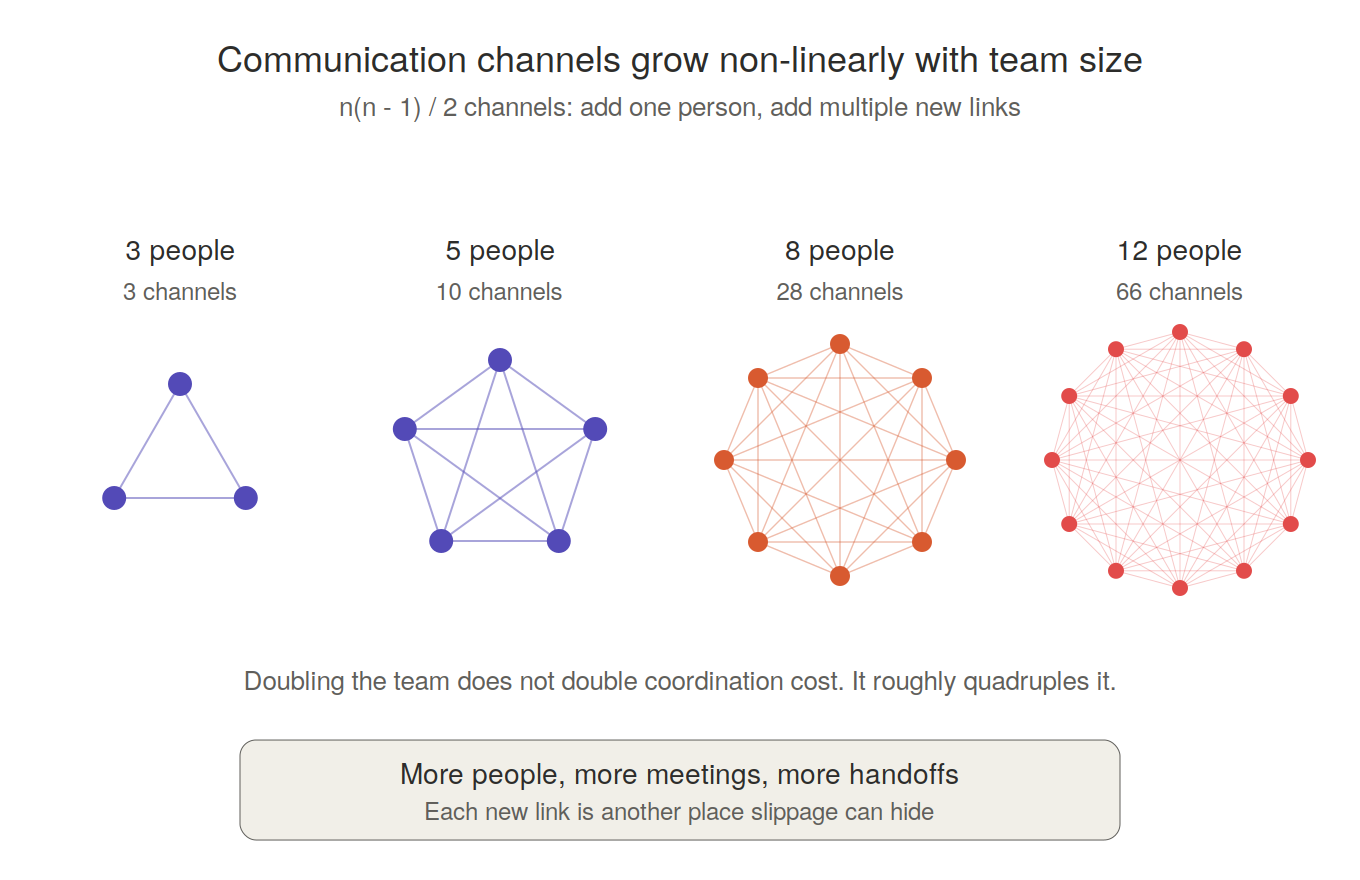
The bigger and more cross-functional a project gets, the more time is spent coordinating it. This coordination overhead grows exponentially, not linearly, with team size, and it's often the unspoken reason large projects slip.
Unproductive meetings, approval bottlenecks, and slow decision-making are the visible symptoms. People spend large parts of their week in conversations about the work rather than doing the work. Decisions wait for sign-offs that take days. Each delay is small; the accumulated total moves the deadline.
Distributed and remote teams add another layer of friction. Time zones, asynchronous communication, the loss of casual corridor conversations: all of it slows information flow. Issues that would have been resolved in five minutes across a desk take a day across email.
Coordination failures between dependent teams are a leading but underreported cause of slippage. They rarely make it into the post-mortem because they're nobody's fault in particular. But the time lost to misaligned handoffs, conflicting assumptions, and unclear ownership is enormous, and almost entirely structural.
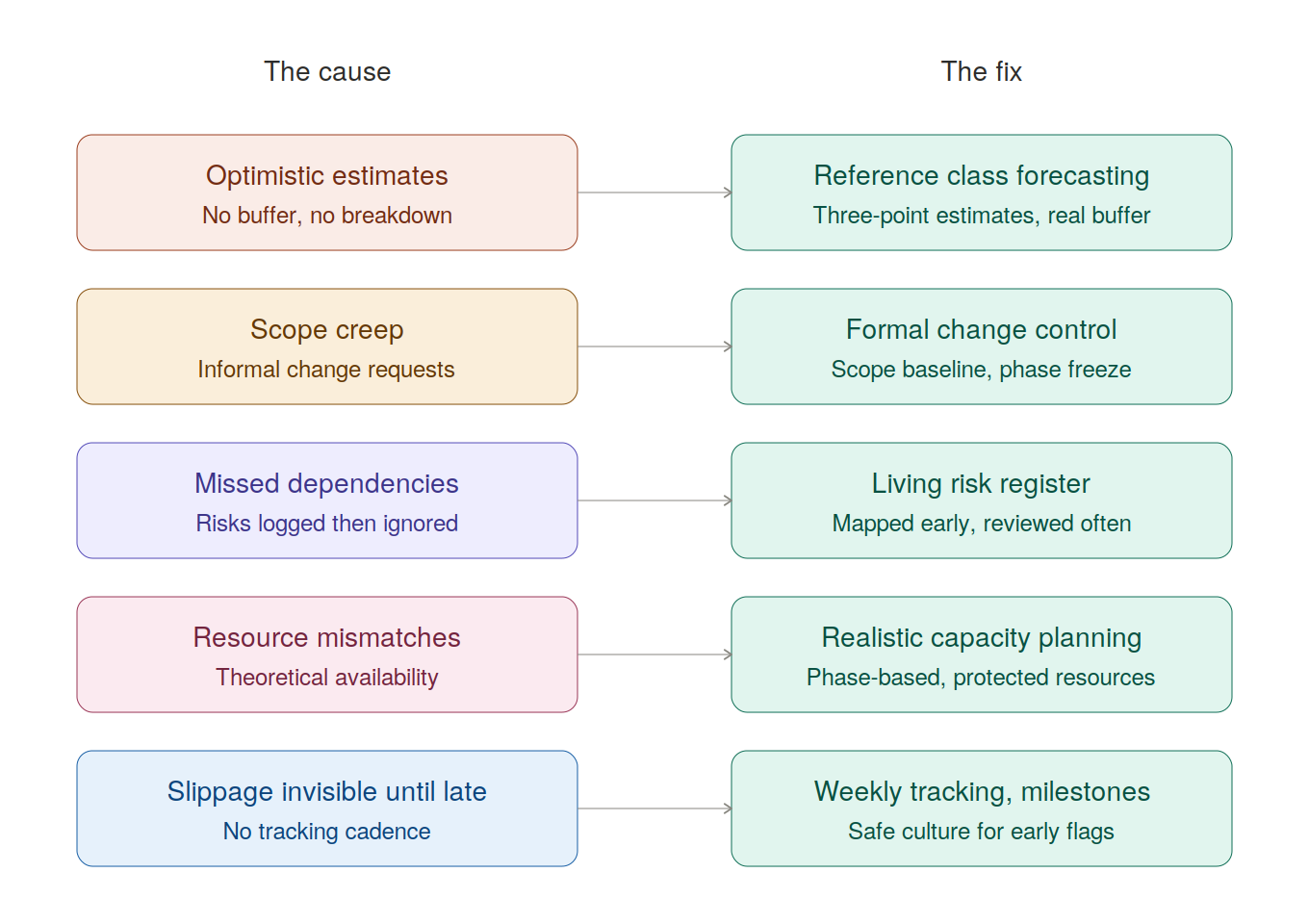
Prevention Methods and Strategies to Stop Deadline Slippage
Knowing why deadlines slip is half the battle. The other half is putting in the practices that stop it. None of what follows requires heavy process or bureaucracy, and at Elite Project Consulting we deliberately keep the scaffolding light, because anything your team won't actually use is worse than no process at all.
Building Accurate Estimates and Realistic Timelines
Better estimates start with better technique. Three powerful methods consistently outperform gut-feel estimation:
Reference class forecasting. Instead of estimating the current project in isolation, look at how long similar projects actually took in the past. Real historical data is far more reliable than internal projection, because it captures the friction the team forgets to include.
Three-point estimation. Rather than a single number, capture an optimistic, most-likely, and pessimistic estimate for each task. The weighted average is almost always closer to reality than a single point estimate, and the spread itself tells you which tasks carry the most uncertainty.
Historical data analysis. If your organisation has run similar projects before, use that data. Look at where previous timelines slipped, and bake the patterns into the new plan.
To counteract the planning fallacy directly, deliberately introduce pessimistic scenario planning. Ask: "If this goes wrong, how does it go wrong?" Build the timeline that survives those scenarios, not the one that survives the best-case.
Breaking large tasks into granular subtasks is one of the single most valuable estimation practices. A vague "build the integration" task hides complexity. Broken into ten subtasks, the hidden work surfaces, and the total estimate is almost always longer (and more accurate) than the single-line version.
Finally, build structured buffer time into the timeline. Not as padding on every task, which just inflates the schedule and gets eroded by deadline pressure, but as protected buffer at the end of each major phase. The buffer absorbs the unexpected without requiring the team to renegotiate dates every time something shifts.
Establishing Rigorous Scope and Change Control
Protecting the deadline means protecting the scope. A formal change request process is the single most effective tool for this: every proposed change is evaluated for its impact on the timeline, cost, and risk profile before it's approved, not after it's already been absorbed.
The point isn't to refuse change, because change is often necessary. The point is to make the cost of every change visible, so the decision to accept it is made with eyes open. When a stakeholder requests an addition, they should see the timeline implication and decide whether the value justifies it. Most won't, and the project keeps moving.
Freezing scope at key milestones is a complementary discipline. Once a phase begins, the scope for that phase is locked. Additional ideas go onto a backlog for the next phase rather than disrupting the current one. This protects momentum in the most fragile stages of delivery, particularly the back half of a project, where late-stage scope changes cause disproportionate damage.
Educating stakeholders is part of the work. Most stakeholders don't introduce changes maliciously. They just don't see the cost. A short, repeatable explanation of how scope changes ripple into the timeline shifts the conversation. Done well, stakeholders start self-policing, filtering their own requests because they understand the trade-off.
A clear scope baseline is what makes all of this possible. It's the reference point against which every change is measured. Without it, there's no objective way to say "this is a change", and scope creep becomes invisible by default.
Strengthening Risk Management Practices
Risk management only works if it's alive. A living risk register, actively reviewed and updated throughout the project lifecycle, is one of the highest-leverage practices in project delivery. The cadence matters more than the format: a simple spreadsheet reviewed every two weeks beats a sophisticated tool reviewed once a quarter.
Identifying project dependencies early is part of the same discipline. Map them before execution starts. Identify which are internal and which are external. Build contingency plans around the ones with the highest impact, so when (not if) one slips, there's a plan ready to deploy.
Quantifying risk impact on the timeline turns risk management from a checklist into a decision tool. If you can say "this risk, if it materialises, costs us three weeks," you can justify the buffer time and resource allocation required to mitigate it. Without that data, contingency feels like overhead; with it, it becomes obvious investment.
Regular risk review meetings, kept short, focused, and ruthlessly practical, keep obstacles from becoming delays. The goal isn't to discuss risk philosophically. It's to ask: what's changed since last time, what new risks have appeared, and what are we doing about the top three?
Improving Resource Planning and Allocation
Resource planning has to start with a realistic availability assessment, not a theoretical one. Before committing to a timeline, confirm who's actually available, when, and at what percentage. Account for holidays, competing commitments, and the inevitable gap between formal availability and effective availability.
Managing resource constraints requires deliberate practices: cross-training so critical skills aren't held by a single person, backfill planning for predictable absences, and workload balancing across the team to prevent burnout in any one role. None of these are dramatic, but together they make a project resilient to the resource fluctuations that would otherwise derail it.
Align staffing decisions with actual project phase demands rather than average needs. Most projects don't require steady-state effort. They require concentrated effort at certain phases. Plan staffing around those peaks, not around an averaged-out resource line that doesn't match the real work shape.
Protect key resources from competing project priorities during critical path work. The person responsible for a critical path deliverable cannot be 30% on three other things. Either they're protected for the duration of that work or the deadline is at risk. Make the trade-off explicit and resolve it at the start, not when the slippage shows up.
Enhancing Communication, Tracking, and Accountability
Establish a project tracking cadence that surfaces slippage signals before they become critical. Weekly is usually right: frequent enough to catch issues early, infrequent enough not to consume the team. The point of tracking is not to generate reports. It's to spot the leading indicators of trouble while there's still time to act.
Milestone-based progress reviews keep accountability anchored across the team. At each milestone, the question isn't just "did we hit it?" It's "what did we learn, and what does that tell us about the rest of the timeline?" Milestones turn the project into a feedback loop rather than a march toward a single end date.
Create a psychologically safe environment where team members can report delays early. This is cultural work as much as process work. If the response to "this task is slipping" is blame, the next person will hide it. If the response is "thanks, what do we need to unblock it?", problems surface while they're still small. The leadership tone on this sets the entire reporting culture.
Use project management tools to maintain real-time visibility into task status, dependencies, and risks. The tool matters less than the discipline of keeping it current. A simple, well-maintained view of where things stand is worth more than a sophisticated platform full of stale data. (This is one of the things we focus on with clients who use platforms like Smartsheet & Asana: the structure exists; the value depends on how rigorously it's used.)
Build a communication plan that keeps stakeholders aligned on priorities, progress, and timeline changes. Predictable communication reduces surprise, and surprise is the enemy of trust. When stakeholders know when they'll hear from you, what they'll hear, and that bad news will arrive early rather than late, the relationship survives the inevitable bumps.
How This Connects to Running a Business with Too Much in Flight
Most of the work above assumes someone is actively running the project: defining scope, holding the cadence, managing risk, protecting the team. When you're a founder or MD trying to do that on top of running the business, the structure that prevents slippage is exactly what falls away first. Not because you don't know it matters, but because there isn't time.
This is the gap we work in at Elite Project Consulting. If your projects keep slipping and the reason is that nobody has the bandwidth to hold the structure together, the broader picture is covered in fractional project management page; Too much on your plate?. It looks at what happens when delivery has outgrown informal coordination, and what to do about it without hiring a permanent PM function.
Conclusion
Project deadlines slip for predictable, structural reasons, and they can be prevented with practices that don't require heavy process. The pattern is consistent: weak planning, uncontrolled scope, missed dependencies, poor communication, inadequate risk management, and execution failures that compound through the project lifecycle. The fix isn't more pressure on the team. It's more structure around the work.
At Elite Project Consulting, working with founders, MDs, and senior leaders across Scotland and the rest of the UK, we bring this structure to organisations where delivery has outgrown what informal coordination can hold together. If your projects keep slipping and the reason is that nobody has the time to hold the structure in place, that's the problem we solve.
For the broader picture of what to do when there's too much in flight, read our page: Too much on your plate?. If you'd like to talk through what's happening on a specific project, book a discovery call. We'll give you an honest read on where the slippage is coming from and what would change it.
FAQ
-
The most common cause is poor upfront planning combined with optimistic time estimates. Plans built without buffer time, without granular task breakdown, and without realistic resource availability are fragile by design. When anything unexpected happens, and something always does, the timeline has no capacity to absorb it.
-
There's no universal figure, but a useful starting point is 15 to 20 percent buffer on each major phase, protected at the end of the phase rather than spread thinly across every task. The exact figure depends on the project's risk profile: higher uncertainty justifies more buffer; well-understood, repeatable work needs less.
-
Generally, once a project is more than 70 percent through its planned timeline, the options for recovery narrow significantly. Beyond that point, recovery usually requires scope reduction, additional resources, or a renegotiated deadline. The earlier slippage is detected, the more options remain, which is why milestone tracking and weekly cadence matter so much.
-
Adding people late introduces onboarding overhead, increases coordination cost, and pulls existing team members into bringing the newcomers up to speed. The productivity gain is often less than the productivity cost, especially in the final phases of a project. This is sometimes called Brooks's Law, and it's why scope reduction or deadline adjustment is usually a better lever than headcount.
-
Look for four things: was the scope clearly defined before the estimate was made; was the estimate broken down into granular tasks rather than handed up as a single number; does the plan account for actual resource availability rather than theoretical; and is there genuine buffer at the end of each phase. If any of these is missing, the deadline is at risk before the project even starts.
“I worked with Paul on a large transformation programme where he was brought in to turn around a particularly challenging project. The client environment was high risk and very complex, but Paul quickly brought structure and calm, breaking an overwhelming brief into a series of clear, manageable projects that together delivered a major change.
I learned a huge amount from Paul about both project and programme management during this time. He combines deep technical know‑how with a very down‑to‑earth, approachable style, making even the most complex delivery plans easy for all stakeholders to understand and get behind. I’d happily work with Paul again on any high-stakes programme.”